What Are You Working On?
General mountain dulcimer or music discussions
I like the idea of setting up such a thread but I am not sure how to go about it. Could you run me through the process?
Hey just an idea, people, but we have the Call the Tune Group which was intended for people to share different versions of the same tune. Someone (John? Gordon?) could start a thread on music for Lent and have people contribute different tunes. That way all those tunes could be found in one convenient place.
Great idea Gordon. Look forward to hearing and seeing your video and others who may join the Lenten theme.
I noticed in the calendar that Ash Wednesday is February 17th, the beginning of Lent and so I have been looking at Lenten hymns. To mark the beginning of Lent I have chosen a Spiritual: "I Want Jesus To Walk With Me". This video will be posted on February 15th.
I admit to having my doubts about that conclusion, John. Are you saying one could tune a low wound D bass string up to the d note an octave higher without it breaking? Not going to try that one myself.
Good experiment to try with a wound string you want to change out anyway though.
I noticed in the calendar that Ash Wednesday is February 17th, the beginning of Lent and so I have been looking at Lenten hymns. To mark the beginning of Lent I have chosen a Spiritual: "I Want Jesus To Walk With Me". This video will be posted on February 15th.
Not to muddy the waters, but to take one element off the table, at least temporarily: hammer and mountain dulcimer pioneer Howie Mitchell wrote about an experiment he made in one of his books. Beginning with a plain (unwound) light gauge steel string he tuned it up tighter and tighter, continuously checking the pitch, until it broke. He replaced it with a heavier string and did the same thing. The thicker string reached the same pitch as the lighter one before breaking. He tried a sill-heavier string and the same thing happened. It reached the same pitch as the other two and snapped. He kept going heavier and kept getting the same result.
So string thickness makes no difference as to what pitch it can be tuned to. The gauge/tension affects tone, playability, and stress on the instrument, but not the highest note it will reach. As Strumelia points out, re-tuning fatigues the metal. Poor installation (like kinking the string while putting it on) and occasionally pinching or binding slots in the nut can also cause breakage. But the thickness of the string is not an issue.
@Ariane I am eager to hear what y'all have come up with! Such a wonderful project!
Thank you very much, my dear friend
Opps, Ken you are exactly correct! Oh well, it's been fun building them; especially since we were not able to go Florida this month.
[quote="John W. McKinstry"]
Hi Jill, Good to hear from you. Yes, I have posted "What a Friend We Have in Jesus" in the video section of FOTMD. I take comfort in playing the old hymns and often play them as a personal meditation time.
John, I too play some of the old hymns for my personal worship and meditation. Try to do that every time I play.
Hi Jill, Good to hear from you. Yes, I have posted "What a Friend We Have in Jesus" in the video section of FOTMD. I take comfort in playing the old hymns and often play them as a personal meditation time.
Kusani -- make sure that your two shapes have the same interior volume (cubic inches), even though that means they will be different sizes. That's the only way to ensure that any tone differences you get will come from the shape not the volume. We KNOW that interior volume differences cause differences in tone -- large volumes = more bari-bass response
I am working on the hymn: "What a Friend We Have in Jesus". Hymnals have it in the key of F with one flat which puts it in a good singing range. I put my dulcimer into F by capo-ing on the 3rd fret while the strings are tuned C G C. I have worked out the three basic chords F, B, and C to accompany my singing of this hymn. I'll do the video of this hymn for FOTMD soon for you to hear and see what I have done.
Hi John, Have you posted the video yet? Thanks for the info! p.s. I too have arthritis - really difficult to do big stretches for chords - but the good news is that I really enjoy noter/drone playing!
@bob I believe I've seen where some other builders made that same move. I imagine it will feel nice to build on your own timetable.
It's indeed a striking collaboration. Thanks for sharing this, Robin.
For those who like enjoy this kind of east-west mashup, you might be interested in the recent Smithsonian Folkways album by Wu Fei and Abigail Washburn and produced by Bela Fleck. Here is a live performance of one of the tunes, which has no dulcimer, unfortunately, but some wonderful singing as well as soothing banjo and guzheng:
Ok, now let's see what string gauges you might need on a 26" vsl dulcimer , for a 1-5-5 tuning for playing in the keys of A and G . (btw a 26" scale is very versatile length for various tunings, but we're sticking with 1-5-5 here)
TrailDad, we know you want a 1-5-5 tuning for the key of A, which would be Aee. On the piano chart I linked to in the last post, you'll see that those two high E notes are one step higher than the standard melody string (d) of the most common dulcimer tuning, DAd. On the piano chart, that high d is the very next key higher than middle C4, and it's shown as the 4th octave on the piano chart, D4. So, for your AEE tuning (or Aee if you want to be perfectly correct), those two strings would be tuned to E4. You always go LOWER for the bass string, so the A note lower than E4 is A3. Thus, your 1-5-5 tuning for key of A will be A3-E4-E4.
Let's see what the Strothers calculator suggests for those notes on a 26" scale.
It suggests a .014 string for the Bass/A string, and a .009 string for the two high e strings.
However, you also know that you'll be wanting to retune all those strings DOWN ONE STEP to play in the key of G, 1-5-5, which is Gdd (G3-D4-D4). For GDD on a 26" dulcimer, the calculator recommends strings of .015, .010 and .010.
I would recommend the more robust set of .015, .010, and .010 for retuning between AEE and GDD in this situation. I've used .009 for high melody strings and have not liked them- I find them so thin they are both unpleasant to play on and they kink and break too easily. Using .010 gives a good feel and the strings will last longer. As to the .015 bass string for the tonic notes A or G, yes that seems pretty thin and indeed it may be a plain unwound steel string, but remember you are tuning to A3 not A2. You are tuning your bass string to the A3 note that is the SAME note as the middle string in the standard DAd tuning. So yes, it's going to need to be thinner than the average bass string.
Now if you wanted to experiment and use the A2 in the octave BELOW the usual D3 bass string in DAd, then you'd need quite a heavy bass string to avoid floppiness on a 26" dulcimer. The calculator calls for a .027 wound string for that A2 note (which they label as A'). That would make it so your two e strings were a 12th up from the tonic A rather than the usual 5th up. Could sound cool, but a bit less traditional. You might also need to widen your slots for a .027 wound string.
Incidentally here's where a "false nut" capo would enable you to put a more normal gauge bass string and work around this. Avoiding odd gauge strings is why people use various tunings and also capos.
So, on a 26" dulcimer vsl, using tunings of 1-5-5 only:
Key of A: A3-E4-E4
Key of G: G3-D4-D4
Both tunings could be achieved by using strings: .015, .010, and .010
I'm happy you enjoyed the video, Nina!
That was incredible. Thanks for posting it. Nina
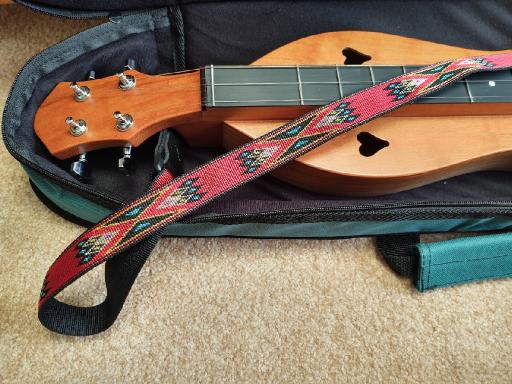
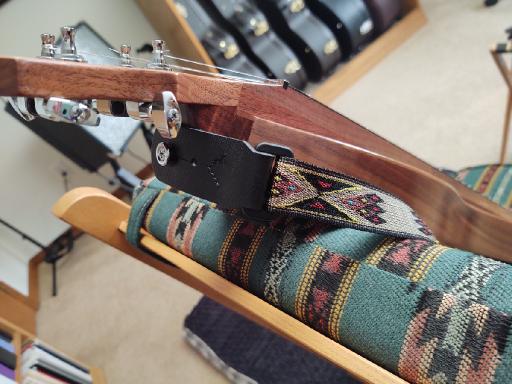
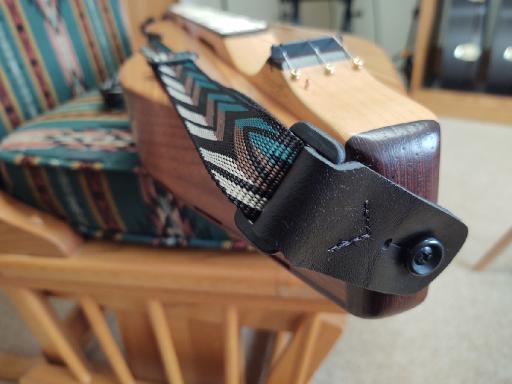
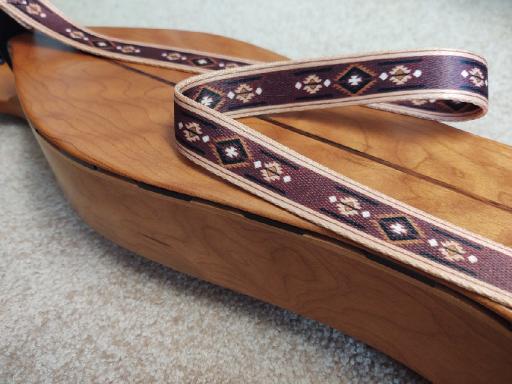
I'm close to finishing an 'experiment'; building two identical dulcimers with the exception of the shape of the body. They are even out of the same board. The reason is to see if I can hear a significant tone difference. I'll post results and pictures when finished.
@bob I believe I've seen where some other builders made that same move. I imagine it will feel nice to build on your own timetable.
I have hit the "Pause Button" on building commissioned dulcimers. Over two years without a break in building special orders is a long run. It's very fulfilling but also rather stressful.
I will however be building mountain dulcimers and scheitholts of my own specs for general sales for a while. It feels refreshing!
Thing to watch out with Sniff.numachi is that most often their tab is listed "backwards" by modern standards -- they list DAA for example as AAD, which gets lots of new players in trouble... Try www.Contemplator.com for those kinds of tunes.

@Ariane I am eager to hear what y'all have come up with! Such a wonderful project!
I'd like to backtrack a bit and try a different approach. TrailDad, I do understand your question. You want to use two different sized just-tempered dulcimers to tune to the four common keys while sticking to only 1-5-5 tuning. I suspect the reason you want to stay with 1-5-5 is because that's the one tuning that your just-tempered instruments will sound 'sweet' in. Switch them to a 1-5-8 tuning for example will sound a bit sour, unless it's an equal tempered instrument. But rather than suggesting you explore a different temperament or vsl or different tuning or gauges, let's try to respond to your exact question and see where we get. :)
Ok, so let's start with assuming you are going to use the standard string setup of having a lower tonic-tuned bass string (that's what 1-5-5 indicates, after all). For ease of understanding, let's also start with the most often used 1-5-5 tuning: DAA, for the key of D .
Let's look at a visual chart of the numbered octaves on the piano, which will help us all stay on the same page:
There, we see that the heavy wound bass string tuned to D would be D3 on the chart.. the D below middle C. The A of the two other strings that are tuned just a 5th above that low D is A3 (still below middle C). So the typical 1-5-5 tuning for key of D is D3-A3-A3 on the piano.
========================
What gauge strings to use for that D3-A3-A3 tuning on a 30" vsl dulcimer? The Strothers calculator tends very slightly towards light gauge recommendations, so if the note you want is between two, choose the heavier option. (Don't just automatically choose a heavier string than the Calculator says.) The Strothers calculator for that DAA tuning on a 30" scale suggests .018 for the bass string and .012 for the other two strings. Now, .018 normally seems pretty light for a wound bass string, but then 30" is a pretty long vsl, so let's continue for a moment...
Now, let's assume you will use the SAME dulcimer to play in C which is only one step down on all strings and is easy to retune to... from DAA to CGG. Looking at the piano chart, you know you will be going DOWN just one step on all strings from D3-A3-A3 to --> C3-G3-G3, and you don't want the strings to feel too floppy. That C3-G3-G3/key of C tuning on the Strothers suggests: a .020 for the bass/C string, and .013 for the other two G strings. Keeping in mind that the Calculator may run a little too light with its suggestions, in this instance between the key of D and the key of C suggestions, we'd choose the slightly heavier option- the key of C suggestions for gauges, to ensure no slack strings. They'd certainly not be so heavy as to break when tuning up one step from CGG to to DAA.
So, for the 30" dulcimer, we'd choose the bass string to be a .020 wound string, and the other two strings to be .013 plain (unwound). That should enable you to tune 1-5-5 on a 30"vsl dulcimer for the keys of both D and C .
I'll examine the same issue but for a slightly shorter dulcimer instead, for the keys of G and A, in my next post but I have some work to do on a job right now and will try to get to it within a few hours. Hope that helps a little?
You're most welcome, Nina! It can be fun just learning bits here and there of our favorite little instrument. :)
I am working on new online project called: "Good Wish Song 2021"
In the relevant dulcimer facebook groups I have posted the following beginning of January:
@dulcinina I listened to the interview yesterday evening-- so good! And just watched this YT video (of a song I have from one of their cd's):
@Traildad, you are making a false assumption that a note using an upper case letter always refers to a note below middle C. I tune my baritone dulcimer GDg. All of those notes are below middle C. I use the lower case g to indicate that the string is an octave above the bass string. I also have an octave baritone dulcimer, meaning it is tuned an octave above that baritone, and I still indicate the tuning as GDg even though only the low G is below middle C and the D and high g are above it. I also have octave dulcimers that I often tune DAd, but all those notes are above middle C.
In other words, the use of the upper and lower case letters shows how the notes relate to each other, not how they relate to some objective standard like a piano.
There are ways to indicate exactly which octave on the piano a given tone is from, but almost none of us bother with that.
Strumelia's blog was not specifically about string gauge, but she does mention that she stopped using a wound bass string and only used string gauges around .10 or .11. The blog post is about how she gets to the main 4 keys of C, D, G, and A with two dulcimers, one that can tune to C and D and one that can tune to G and A.
If all you want to know is what octaves one uses for 1-5-5 tunings in those four keys . . .
C-G-G would usually be C3-G3-G3
D-A-A would usually be D3-A3-A3
G-D-D would be either G2-D3-D3 (as a baritone) or G3-D4-D4 (as a 3/4-size instrument like a Ginger)
A-E-E would be either A2-E3-E3 (as a baritone) or A3-E4-E4 (as a 3/4-size instrument)
Of all those notes, only the D4 and E4 are above middle C.
I’m working on getting two just intonation dulcimers. Unfortunately one of them had a major fret placement defect and was unplayable. Hopefully I can get it replaced and I’ll be able to change keys like I want without restringing.
@Strumelia I went back and reviewed the blog posts
https://dulcimer-noter-drone.blogspot.com/2009/03/tunings-i-mostly-use.html
https://dulcimer-noter-drone.blogspot.com/2009/02/here-is-simple-diagram-i-made-up-to.html
and your response to Ron dated 2/24/2009.
Many times in both blog posts and your response to Ron you refer to the tunings DAA, CGC, CGG, EAE, DGD, CCG, AEE, GDD all to describe tuning in the keys of A,C,D and G. Nowhere do you mention a galax or the special tuning you now refer to with the .010 strings. I will admit that my question “ I’m trying to figure out which octaves all the notes are for each key.” could have included more detail. But the question is pretty straightforward and all the tunings are standard tunings and to my knowledge have nothing to do with the specialized galax tuning. I would hope it was clear that my question was about the different tunings you referred to in your blog. I still don’t understand why your answer was about string size instead of what octaves the notes are in. It is possible that the octaves are notated correctly and all strings are tuned below middle c. I am still trying to get what I thought was a simple question answered. I am sorry that I make you pull your hair out.
Thing to watch out with Sniff.numachi is that most often their tab is listed "backwards" by modern standards -- they list DAA for example as AAD, which gets lots of new players in trouble... Try www.Contemplator.com for those kinds of tunes.
Thanks, Nina-- I'll have to check it out!
Jeff Berman & Sue Powers played a little outdoor show with another group of which the are a part, Devilish Merry, in '19 and I got to see them in that yet would also love to see AppalAsia 'live', too.
Hi Robin, There is an interview of the group AppalAsia on Hearts of the Dulcimer Podcast. It's episode #021. Nina
I try to play Cam Ye O'er Frae France on dulcimer. I discovered a site which has a kind of tab (although it's auto generated thus might be wrong): http://sniff.numachi.com/pages/tiCAMFRANC;ttCAMFRANC.html
Nontheless the tune sounds good, but I need practice, practice, pratice :)
Hi Ken
Thanks for all the helpful information. The pictures you posted do look remarkably similar to my device. The only difference is the bridge arrangement.
Thanks to you and everyone for your replies. I think judging from the amount of dust I extracted from the sound box Lisa is right about the vintage !!
I just watched this video from AppalAsia this morning and like it very much.
Trapezoid shaped dulcimers dulcimers have been made for decades, though they're not as commonly produced as curve sided dulcimers. If I had to guess, Mick's used homemade dulcimer looks to be maybe from the 1970s or 80s. Yes Robin Clark made a few box dulcimers, but only within the past several years.
Didn't Robin Clark up in Wales do some trapezoid dulcimers?
Mick, here is a link to article by Jerry Rockwell on the Bear Meadows Dulcimer site: https://www.bearmeadow.com/smi/rockwell.htm . If you scroll down to near the end of the article, there information about tuning.
I hope this helps you.
Ken
"The dulcimer sings a sweet song."
In a book by Reader's Digest many years ago there were plans for a dulcimer similar to your. The book is titled Back to Basics. Here is a phot of the article and a photo of a similar dulcimer.
Ken
"The dulcimer sings a sweet song."